Main Program
14-16 October 2026 | Melbourne Convention & Exhibition Centre
Browse the program and start planning your CyberCon 2026 experience across three days of keynotes, panels, workshops, and more.
Results 1
Showing1 to 3 of 6
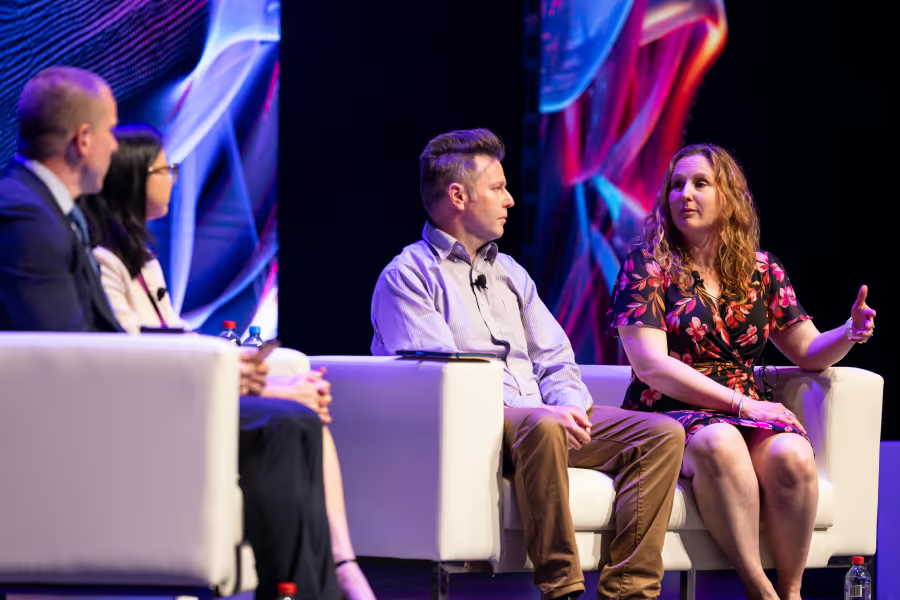
Three experts. Three perspectives. One conversation about human risk management because it isn’t working the way we think it is


Three human risk management practitioners debate why awareness training and phishing metrics fail to change behaviour, and what actually works instead.
Defending against hidden risks of AI tools in the workplace
AI tools have the power to transform organizational productivity while exponentially increasing risk. Join this session to uncover how workplace AI tools can expose sensitive data, bypass controls, and introduce new attack surfaces. We’ll also explore what you can do to mitigate these risks effectively without impeding innovation.
RAWthority: Professional storytelling for career success

A workshop to pin down the job you want and turn the experience that makes you credible into a LinkedIn profile and story employers notice before an interview.
Who owns what when AI fails? The GenAI shared responsibility model for AI risk across every use case

A shared responsibility model maps AI security accountability across deployment tiers, showing which risks are yours and which belong to vendors.
Blue wins if we cheat (and that's fair) home-turf advantage for AI defenders in Active Directory

Pitting autonomous AI agents against each other in Active Directory shows defenders lose not from weak models but from withholding environment context.
From pallets to packets: A story about people, reinvention, and success

A cyber security leader's journey from early hardship to a career in IT distribution, cloud hosting and security leadership shows how reinvention works.
How to continuously prioritise and justify your cyber investment based on quantified risk



A panel on how combining risk quantification with continuous exposure management grounds cyber investment in validated, exploitable exposure data.
Finding the weak spot: Rethinking how we assess control effectiveness

Borrowing Formula 1's shift to proactive failure analysis, this session introduces a method for testing whether security controls hold under pressure.
Preserving the capacity to defend: When global cyber threats meet fragmented regulation

As cyber obligations multiply across jurisdictions, the real risk is regulatory fragmentation diverting effort into coordination rather than resilience.
How I learned to stop worrying and build a CBOM - practical steps for quantum resilience

A cryptographic bill of materials is the essential first step toward quantum-resilient architecture, and this session gives a practical blueprint for one.
When fraud stops looking like fraud: Why detection fails in cross-chain financial crime and what we must do next?

Cross-chain financial crime increasingly mimics legitimate blockchain activity, so detection needs to shift from anomalies to behavioural context.
Real-time data breach assessments: Bridging data governance and security logging

A practical architecture bridges security logging and data governance so organisations can identify affected individuals fast enough for reporting deadlines.
Human still matters: How security culture professionals stay relevant in the age of AI


Human in the Loop and Human on the Loop are the concepts used to sort security awareness work into what AI can automate and what must stay human-led.
When the playbook burns: AI accelerated incidents and the response gap killing Australian organisations


An AI-augmented ransomware attack made a rehearsed incident response plan irrelevant within 90 minutes, exposing gaps regulators now penalise.
Who's accountable when AI acts with credentials

Identity frameworks built for humans fail when AI agents act autonomously with legitimate credentials, and this session maps that accountability gap.
Your website has a new front door: Generative AI wants in, and the attackers are already there


As generative AI crawlers and agentic browsers surge, websites need a framework to distinguish trustworthy automation from attackers using the same access.
Experts as a service: Crowd-based forecasting for cyber risk quantification

Crowd-based expert forecasting turns distributed security knowledge into a calibrated, dollar-denominated risk signal for assets no scanner can reach.
Perception is not assurance: What validated assessments reveal about SME cyber security

Multi-year research into validated SME assessments reveals a governance blind spot where self-reported confidence still substitutes for real cyber assurance.
Compliant, but still exposed: Rethinking OT cyber risk as an architectural problem

Using Colonial Pipeline and Stuxnet as examples, this session shows why OT risk increasingly comes from architecture and dependencies, not missing controls.
The first 24 Hours: Checklists, choices and chaos in cyber crisis response

Well-designed checklists for the first two, eight and twenty-four hours of a cyber incident turn chaotic decision-making into calm, coordinated response.
No silver bullets: Securing sensitive data, a problem as old as digital data itself
Customer and vendor explain a failed data protection project differently, and both are usually right. The lessons then drive change in a complex enterprise.
Lunch
Exhibition Closes
Anthropic CISO session with Jason Clinton

Anthropic Deputy CISO Jason Clinton spent more than a decade at Google, where he led Chrome infrastructure security against advanced persistent threats.
Secure your place at CyberCon 2026
Join thousands of cyber security professionals in Melbourne this October.