
Main Program
14-16 October 2026 | Melbourne Convention & Exhibition Centre
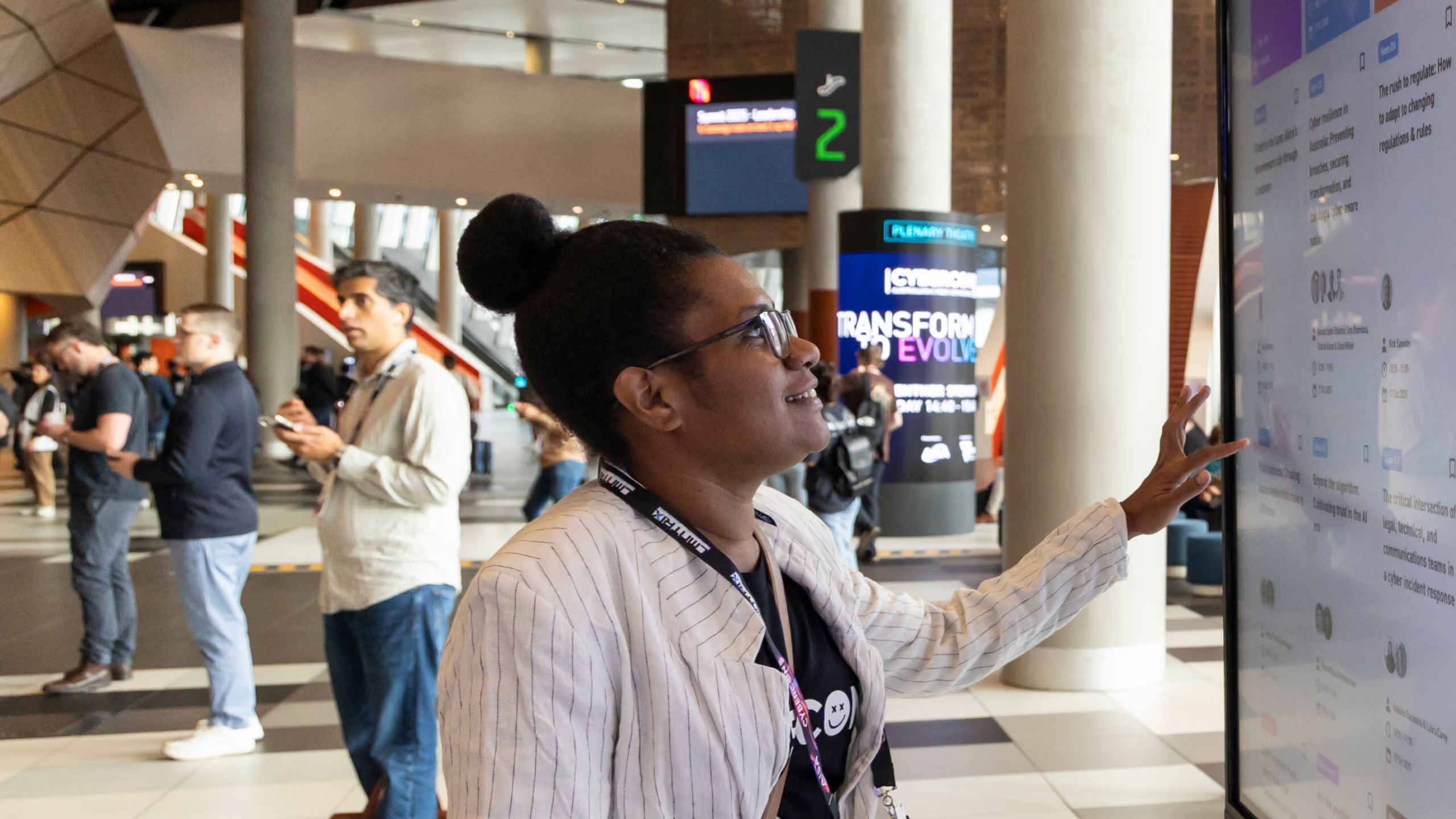
Browse the program and start planning your CyberCon 2026 experience across three days of keynotes, panels, workshops, and more.
Results 1
Showing1 to 3 of 6
If this, then breach - AI-Assisted red teaming without malware, infrastructure, or exploits

AI now lets red teamers chain everyday SaaS access and automation into high-impact breaches without deploying malware or touching an endpoint.
The new cyber security topography: Sovereign risk, AI readiness & the evolving cyber landscape

National briefing findings on sovereign risk and AI readiness show organisations still need to nail identity, access and data governance basics first.
Trusting agents with your secrets: What OpenBao taught us about Agentic Identity

A practitioner's account of testing OpenBao as a secrets management foundation for autonomous agents, covering what worked and where it fell short.
Domain Zero: Human threat intelligence is cyber's unfinished business

Cyber threat intelligence methodology extends to human-motivated threats, showing how structured behavioural indicators can detect social engineering earlier.
DMARC can’t see this: Where brand impersonation hides in plain sight

Brand impersonation is shifting from email to social platforms, bypassing DMARC entirely, and this session shows how to extend detection beyond the inbox.
Ask me about people, culture and workforce development or leadership, governance and accountability

James Morphett is in Ask an Expert 1 at 2.20pm Thursday for people, culture and workforce development or leadership, governance and accountability.
Code by vibes, breach by design: Securing the non-coder revolution
Applications built by prompt carry injection flaws and weak authentication, and a container isolates the environment without fixing the broken logic inside.
Afternoon Tea
Challenges of governing the ungovernable & security leadership in the age of AI autonomy




Security executives share lessons from real AI-driven incidents on governing autonomous agents that already make decisions with minimal human oversight.
Navigating cyber insurance in uncertain times - wars, systemic events, AI and beyond




Geopolitical instability, systemic events, and AI are reshaping cyber insurance markets, changing how insurers price and assess risk for buyers.
Unified, automated, and powered by agentic AI: The SOC reimagined
Guardrails and human expertise sit alongside the automation in the SOC described, where AI agents triage alerts and initiate response actions.
Hack your job search: The human side of getting hired

What is broken in cyber recruitment right now? Laura Mackay's Careers Village talk on the human side of getting hired asks it at 3.50pm Thursday.
Same humans, smarter attacker: What three years of AI development has done to security awareness training

New research shows AI now runs personalised social engineering attacks as effectively as it once simulated them, testing today's training frameworks.
Guarding the pipeline: Hardening GitHub actions against supply chain attacks

Misconfigured GitHub Actions pipelines are an increasingly attractive supply chain target, and this talk offers practical guidance for hardening CI/CD.
Phishing isn't an awareness strategy: The behavioural science behind why your human risk program is broken

Behavioural science explains why annual training and phishing simulations rarely change behaviour, and what an evidence-based human risk program needs instead.
Hacked attention: A father–son story of ADHD as a cyber security superpower


A father and son in cyber security share how ADHD traits such as hyperfocus become strengths in threat detection and incident response.
Human out of the loop: The AI success story nobody is planning for

Compensating human workarounds inside operational data pipelines become invisible risk once AI quietly replaces the people who were fixing broken data.
The front line – Scambaiters – a need to develop a closer relationship with authorities

Four years of scambaiting data shows the real intelligence value of disrupting fraudsters, and why closer ties with authorities would help victims more.
Quantum automation for cyber defence: Moving beyond classical limits in real-time threat response

Quantum computing's ability to process vast data quickly could move cyber defence beyond the limits of classical real-time threat response.
BTCScamFinder: Catching crypto scam sites before the first victim pays and tracing the criminals behind them

An open-source pipeline flags crypto scam sites within hours of launch and traces stolen funds through a fully auditable evidence chain.
Better plumbing in security: Bringing pipes to SQL

SQL pipe syntax makes SQL usable for security hunts and detection logic, potentially breaking down the query-language silos between SIEMs and analysts.
When the victim panics: The missing layer in cyber incident response

Victims under pressure delay reporting, hide evidence and make rash decisions, so response models need to stabilise people before technical response begins.
Preparing for ransomware and commodity malware in OT environments

Beyond state-sponsored sabotage headlines, most OT organisations' real incident response work involves ransomware and commodity malware on ageing systems.
Strategy is not activity: Why cyber leaders mistake motion with progress

Busy dashboards and expanding controls can mask strategic failure, and this session shows how to separate genuine risk reduction from well-organised activity.
Secure your place at CyberCon 2026
Join thousands of cyber security professionals in Melbourne this October.







