Program
14-16 October 2026
Melbourne Convention & Exhibition Centre
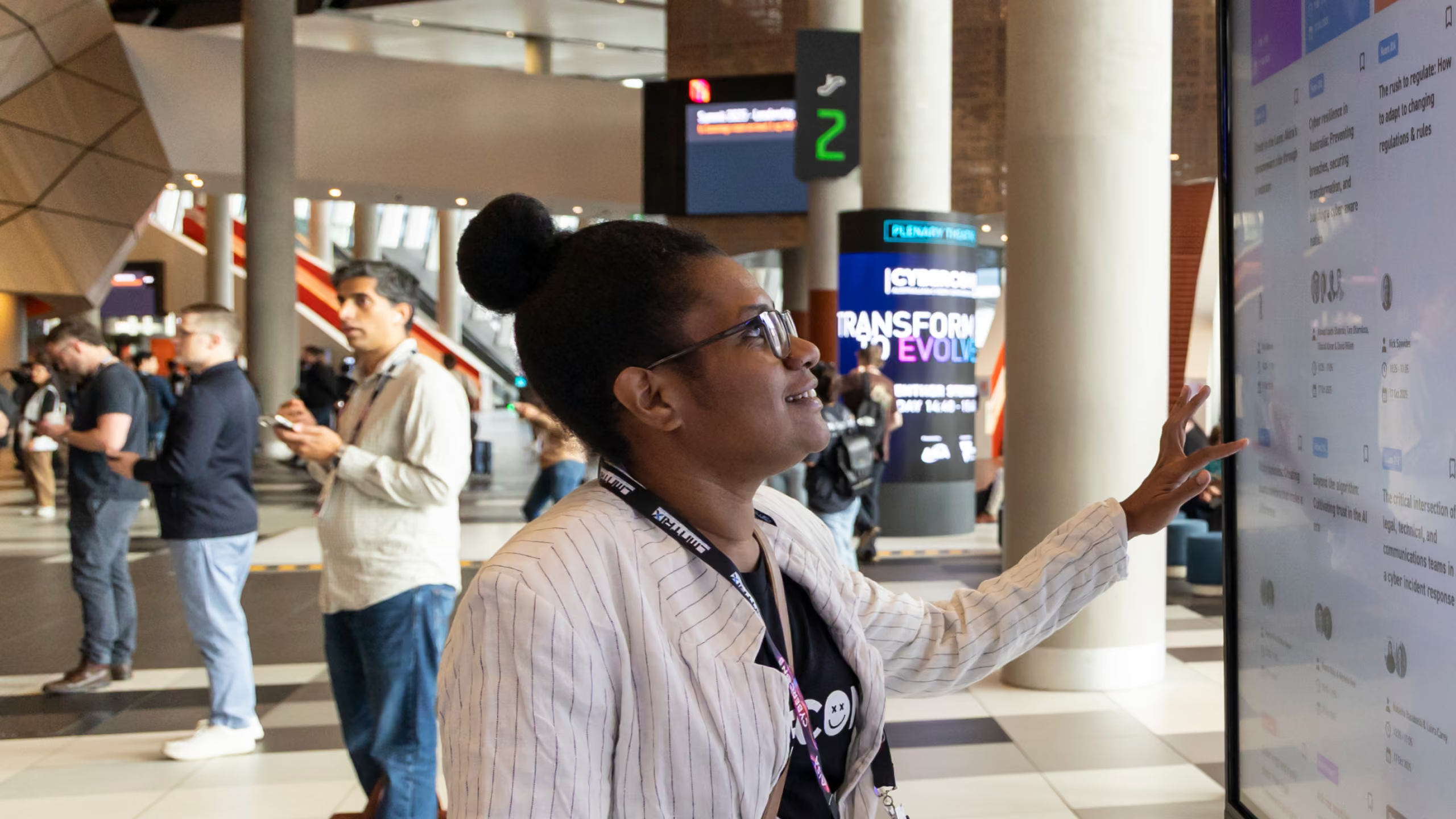
Browse the program and start planning your CyberCon 2026 experience across three days of keynotes, panels, workshops, and more.
Results 1
Showing1 to 3 of 6

We built security for perfect humans. Attackers didn’t.
Automating tier-one triage didn't remove human error from security operations, it just relocated it upstream into detection logic nobody revisits.
Incident response under pressure: parallels between firefighting and cyber attacks
Frontline firefighting experience shows why calm leadership, rigorous training, and regular tabletop exercises decide how teams perform during cyber incidents.
Too young for the room
A breakout session on how seniority bias and credentialism keep young cyber talent invisible, traced through one 15-year-old's path from locksport to the stage.
Nobody warned us: Battle scars from breaking, fixing and surviving E8 in the real world- without breaking the bank
Two contrasting real-world Essential Eight rollouts, one well-funded and one not, reveal why planning and roadmap discipline matter more than budget.
What happens if we’re wrong? Scenario analysis and the future of cyber security services
Scenario analysis stress-tests four cyber security service models against AI, geopolitical and social shifts to prepare for an unpredictable future.
Buzzkill: How using hacker tools can get you owned
Now-patched vulnerabilities in the popular BBOT attack surface mapping tool show how offensive security software can expose the pentesters using it.
From submarines to boardrooms: Executive risk lessons from hacking military hardware
Lessons from hacking a submarine's control systems shape five principles for communicating technical risk in terms executives will act on.
Your AI runs on vibes, not rules: Can you prove your agent made the right decision?
New automated decision-making disclosure laws demand a reasoning chain from autonomous agents, and this session presents primitives for runtime governance.
Sure Dave, I can to that! - LLM-Driven malware development
Breaking a malware build into small, legitimate-looking requests across multiple LLMs reliably bypasses safety refusals, a gap current safeguards don't close.
The new control plane of macOS security
Modern macOS trust decisions are enforced through a distributed web of code-signing, entitlements and policy daemons most defenders treat as isolated controls.
How AI changes your ISO 27001 certification requirements
AI adoption is outpacing ISMS updates, and this session, from an auditor's view, sets out what to change before your next surveillance audit.
School to SOC - 30 mistakes in 30 days
Thirty common mistakes new SOC analysts make in their first month reveal the gap between studying security theory and triaging live alerts under pressure.
CTI at the coalface in 2026: Expert panel
Australian cyber threat intelligence practitioners share war stories, common misconceptions, and what actually builds an impactful CTI practice.
Three experts. Three perspectives. One conversation about human risk management because it isn’t working the way we think it is
Three human risk management practitioners debate why awareness training and phishing metrics fail to change behaviour, and what actually works instead.
Who owns what when AI fails? The GenAI shared responsibility model for AI risk across every use case
A shared responsibility model maps AI security accountability across deployment tiers, showing which risks are yours and which belong to vendors.
Blue wins if we cheat (and that's fair) home-turf advantage for AI defenders in Active Directory
Pitting autonomous AI agents against each other in Active Directory shows defenders lose not from weak models but from withholding environment context.
From pallets to packets: A story about people, reinvention, and success
A cyber security leader's journey from early hardship to a career in IT distribution, cloud hosting and security leadership shows how reinvention works.
How to continuously prioritise and justify your cyber investment based on quantified risk
A panel on how combining risk quantification with continuous exposure management grounds cyber investment in validated, exploitable exposure data.
Finding the weak spot: Rethinking how we assess control effectiveness
Borrowing Formula 1's shift to proactive failure analysis, this session introduces a method for testing whether security controls hold under pressure.
Can cyber regulation keep pace with a fragmented threat environment?
As cyber obligations multiply across jurisdictions, the real risk is regulatory fragmentation diverting effort into coordination rather than resilience.
How I learned to stop worrying and build a CBOM - practical steps for quantum resilience
A cryptographic bill of materials is the essential first step toward quantum-resilient architecture, and this session gives a practical blueprint for one.
When fraud stops looking like fraud: Why detection fails in cross-chain financial crime and what we must do next?
Cross-chain financial crime increasingly mimics legitimate blockchain activity, so detection needs to shift from anomalies to behavioural context.
Real-time data breach assessments: Bridging data governance and security logging
A practical architecture bridges security logging and data governance so organisations can identify affected individuals fast enough for reporting deadlines.
Why cyber practitioners should train like doctors: What clinical thinking does for cyber defence
Cyber practice lacks medicine's clinical diagnostic method, and 25 years of case studies show threat intelligence often answers questions nobody asked.
Secure your place at cybercon 2026
Register now and save! Discount ends Wednesday 30 September 2026.